
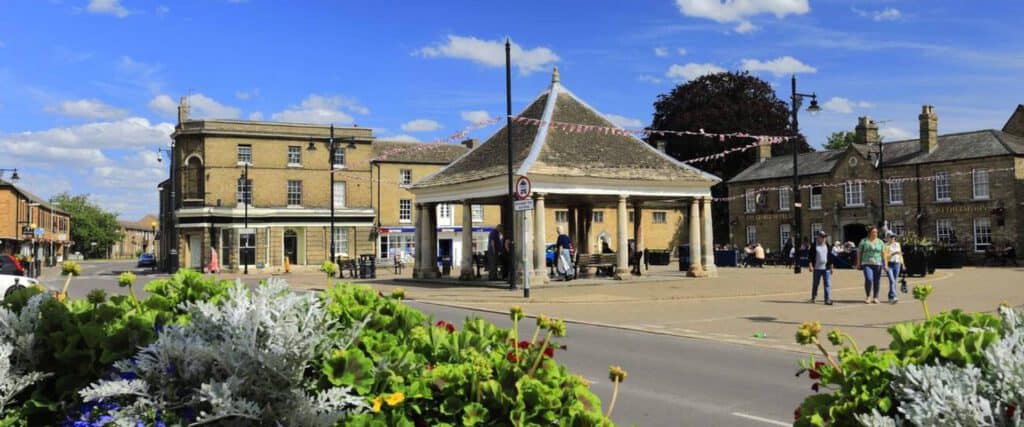
Our Mission
The Whittlesey Charity has its origins in several ancient charities, some dating as far back as the 1600’s.
The Charity holds most of its assets in farmland, from which it generates income in the form of rents from its agricultural tenants.
This income is allocated annually to the Charity’s four funds:
- Education
- Relief in Need
- Public Purposes
- Church
This income is used to support both community projects and individuals, encompassing events such as Straw Bear and The Whittlesey Festival.
The Charity also holds Manorial Lands and buildings such as the Town Hall, bequeathed by the late Lady of the Manor, Nancy Bowker.
The Charity is governed by its charitable order, and its trustees currently consist of a Chair, Vice Chair and eight trustees, all of whom have extensive knowledge in a range of areas such as Education, Finance and Land Management.
The day to day running of the Charity is looked after by the clerk, Mary Johnson.
Our History
The Whittlesey Charity has been gifted land, property, and, in some cases, money for the town’s and its residents’ benefit. These gifts can be traced back over 400 years and are recorded on The Decree of Pious Uses dated June 1668. This decree set out a scheme for how charitable gifts were to be administered, and it remained in place until 1898, when the Charity Commission created a scheme that brought The Whittlesey Town Lands Charity into being.
Further gifts were made in the 1700s and again in the 19th Century when The Whittlesey United Charity was created. The most recent gifts to be received were from the will of John Sudbury, which resulted in the creation of the Sudbury’s Charity and from Lady of the Manor, Nancy Bowker, which included ownership of the Greens in Coates and several droves in and around Whittlesey, Eastrea, Turves and Blackbush. In 1990, the three charities (Whittlesey Town Land Charity, The Whittlesey United Charity and Sudbury’s Charity) were amalgamated to form the current Whittlesey Charity.
Copies of A Short History of The Whittlesey Charity, giving further details of the charity’s history, can be purchased from The Whittlesey Museum or on request from the clerk at clerk@thewhittleseycharity.co.uk.
Earliest Records
Earliest records of charitable gifts to the town of Whittlesea.
Parliamentary Charity Act
General Statute passed in the High Court of Parliament beholden to Queen Elizabeth 1st, being “an Act to redress the misemployment of Lands Goods.
Pious Uses Decree
General Statute passed in the High Court of Parliament beholden to Queen Elizabeth 1st, being “an Act to redress the misemployment of Lands Goods and Stocks of Money heretofore given for Charitable Uses”.
Town Hall
First version of the building, to be called the Town Hall, built on Almshouse Street (Market Street), on the Almshouse Yard, between The Black Bull and William Read’s property. The two storey pitch roofed brick building, to be an engine house for the towns four Fire Engines, with two meeting rooms on the 1st floor above them.
United Charities Formed
‘The Whittlesey United Charities’ formed by a scheme made by the Charity Commission, merging Kelful’s, Randall’s and Dow’s Gift charities.
Horseshoe Table Made
The Horseshoe Table and Chairman’s Platform are made for the Meeting Room by W. Andrews, costing £31!
Town Lands Charity
Town Lands Charity formed.
Fire Engine Modifications
New Fire Engines purchased for the town have an increased axle width due to redesigned wheel hubs. They are too wide to fit through the engine room door frames! The frames have to be notched on each side, enabling entry and continued Fire Engine storage in the building.
WWII Begins
WWII starts, building is used as an Air Raid Wardens Post. Windows were blacked out to prevent light from shining through at night.
COIF Investment Fund
Charities Commission set up the Charities Official Investment Fund (COIF) for use by UK Charities.
Whittlesey Museum Opens
On the 1st of May 1976, the Whittlesey Museum opened its doors for the first time in the Town Hall, operating as a separate entity under a lease granted by The Whittlesey Charity.
Charity Consolidation Complete
‘The Whittlesey Charity’ formed from three previous Charities: Sudbury’s, Town Lands and United. Occasion marked with the installation of a projecting non-illuminated clock on the front wall of the Town Hall. Hayward Horological from Ipswich manufactured and installed the clock, with permission granted by Fenland District Council
Charity Consolidation Complete
Dick Hinton’s book ‘A short History of the Whittlesey Charity’ Published.
New Clerk Appointed
Charities Clerk – Dick Hinton, dies after 40 years’ service. Trustee Philip Gray appointed as Clerk.
Manorial Lands Bequest
Whittlesey – Nancy Bowker (Lady of the Manor) dies, bequeathing her Manorial lands to the Charity.
Oldfield's Book Published
Trustee, Geoff Oldfield, publishes his book; ‘The Governors of the Town Revenues of Whittlesey’ based upon entries from ‘The Town Book 1668 to 1898’ owned by the Charities.
First Female Chair
Claire Rayner becomes the first female Chair of The Whittlesey Charity.
Clerk Succession
Phil Gray retires as Clerk, replaced by Graham Abblitt.
Covid Virtual Meetings
Covid Pandemic, Charity meetings after February, held via the internet using ‘Zoom’ meeting application. Countrywide lockdown is enforced, preventing meetings of groups
First Female Clerk
Graham Abblitt retires as Clerk, replaced by Mary Johnson (first female clerk)